
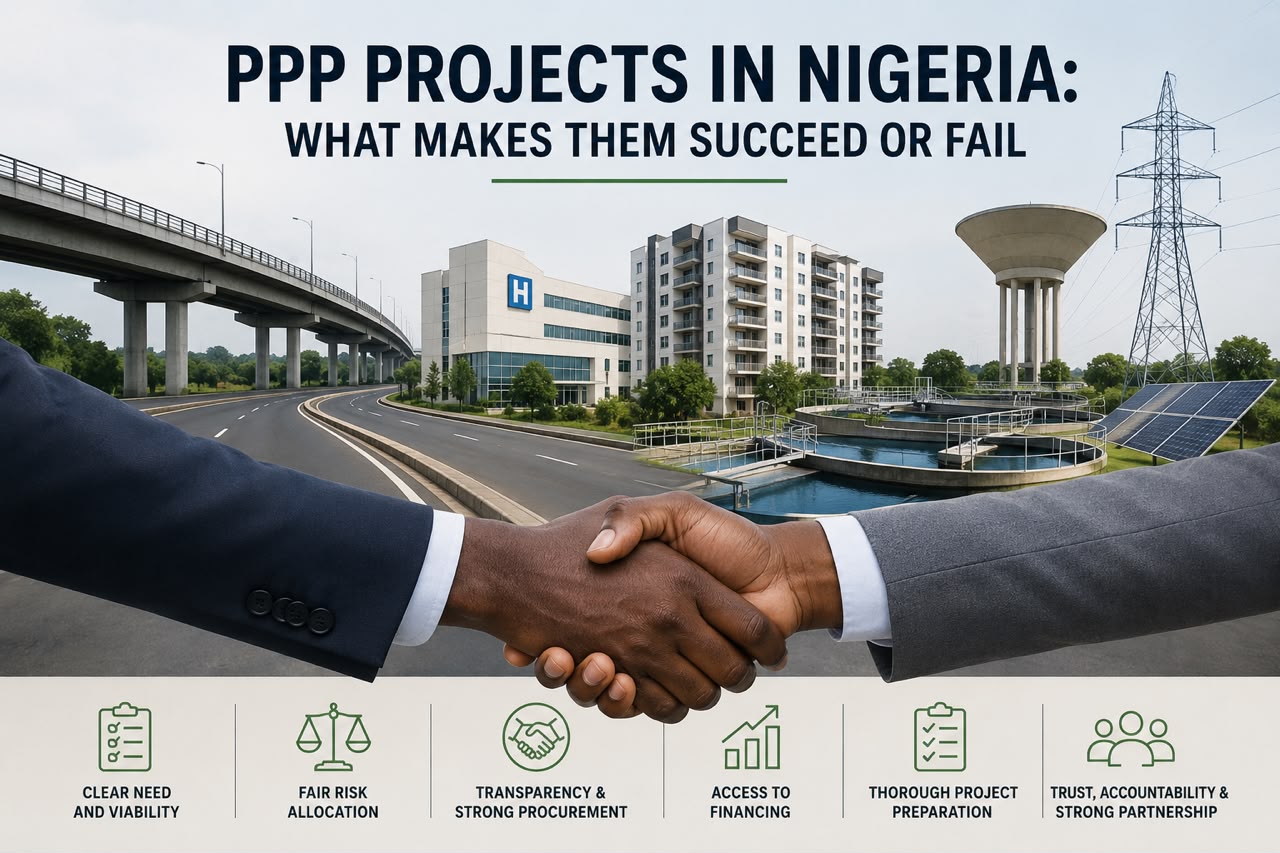
Public-Private Partnerships (PPPs) have become an important option for addressing Nigeria’s infrastructure needs. With growing demands for roads, housing, power, healthcare facilities, water systems, transport networks, and public amenities, government funding alone is often insufficient to deliver every required project at the necessary scale and speed. PPPs offer a practical alternative by combining public-sector responsibility with private-sector finance, expertise, innovation, and operational capacity. However, while the model holds significant potential, its success depends on far more than signing an agreement.
A successful PPP begins with a project that addresses a genuine public need. The proposed asset or service must have clear economic or social value, realistic demand, and a defined source of revenue or government support. A toll road, for example, must be supported by credible traffic forecasts, while a housing, healthcare, or water project must be based on a realistic understanding of users’ needs and ability to pay. When projects are selected for political visibility rather than long-term viability, they are more likely to face delays, disputes, or financial difficulties.
Clear allocation of risk is another essential factor. In a well-structured PPP, each party should manage the risks it is best positioned to control. The private partner may be responsible for construction quality, delivery timelines, and operational performance, while government may take responsibility for land acquisition, regulatory approvals, and certain political or policy-related risks. Problems arise when risks are poorly understood, unfairly transferred, or left undefined. A contractor cannot reasonably absorb delays caused by unresolved right-of-way issues, changing approvals, or government payment obligations.
Transparency and strong procurement processes are equally important. Private investors need confidence that projects will be awarded fairly, that contract terms will be respected, and that decisions will not change unexpectedly after financial commitments have been made. Competitive bidding, clear evaluation criteria, proper due diligence, and detailed contractual documentation help attract credible partners and protect public interest. They also reduce the likelihood of inflated costs, poorly qualified concessionaires, and disputes that can stall delivery.
Financing remains one of the most challenging aspects of PPP implementation in Nigeria. High interest rates, exchange-rate volatility, limited access to long-term funding, and uncertainty around revenue generation can make projects difficult to finance. For PPPs to succeed, financial models must be realistic and flexible enough to respond to changing economic conditions. Government guarantees, viability-gap funding, blended finance, and support from development-finance institutions can help make strategically important projects more bankable.
Project preparation should never be underestimated. Before procurement begins, sponsors must carry out sound feasibility studies, environmental assessments, legal reviews, demand analysis, and cost estimates. Is the project technically achievable? Is the revenue model sustainable? Have affected communities been consulted? Are environmental and social risks properly addressed? These early decisions often determine whether a project becomes a valuable public asset or an expensive unfinished promise.
Ultimately, PPPs succeed when they are built on trust, competent project management, realistic commercial terms, and accountability throughout the project life cycle. They fail when expectations are unclear, risks are ignored, and parties treat the arrangement as a short-term transaction rather than a long-term partnership.
At Samprec Consultants Ltd, we support clients in navigating complex infrastructure and development projects through project management, cost management, procurement advisory, and construction consultancy services. Our focus is on helping stakeholders make informed decisions and deliver projects that are commercially sound, efficiently managed, and built for lasting value.
Leave A Comment