
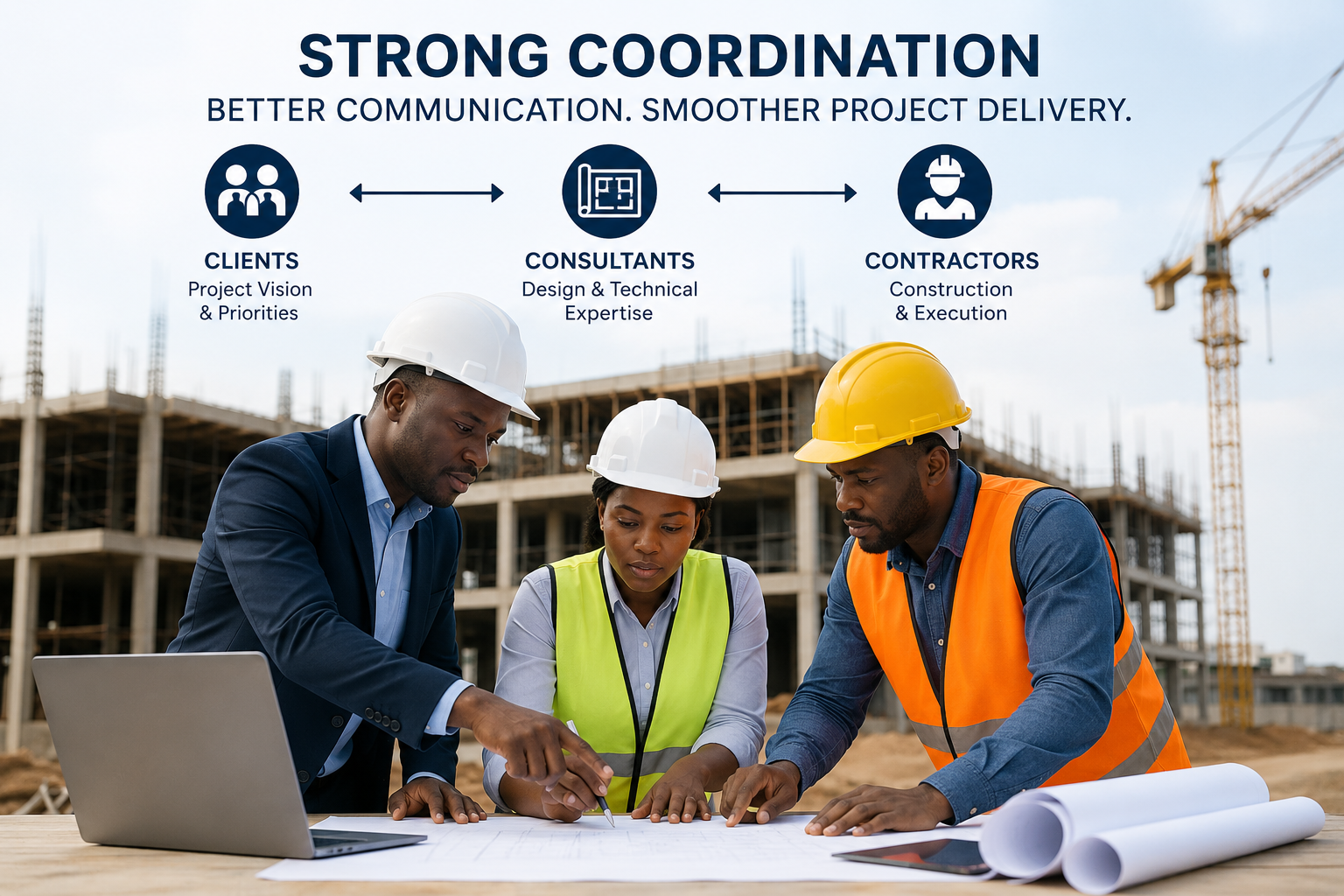
Construction projects rarely fail because one party lacks technical competence. More often, difficulties arise when contractors, consultants, and clients are not working from the same understanding of scope, priorities, decisions, and timelines. A project may have capable professionals, approved drawings, and adequate resources, yet still experience delays, variations, disputes, and cost overruns when communication breaks down on site. Effective coordination is therefore not an administrative exercise; it is a core requirement for successful project delivery.
The client sets the project vision, funding priorities, and expected outcomes. Consultants translate that vision into designs, specifications, budgets, and contract requirements, while contractors transform those plans into physical work. Each party has a distinct responsibility, but the project can only move efficiently when those responsibilities are connected through clear communication and timely decision-making. When information is delayed or instructions are unclear, even minor issues can quickly affect progress, quality, and cost.
One of the most important foundations for coordination is a clearly defined project scope. Before work begins, all parties should have a shared understanding of what is to be delivered, the quality standards required, the programme for completion, and the approval process for changes. Ambiguity at this stage often leads to conflicting expectations later. For example, if the contractor proceeds based on an interpretation that differs from the consultant’s design intent, who bears the cost and time implications of corrective work? Clear documentation helps prevent such uncertainty.
Regular site meetings also play a vital role. These meetings should go beyond routine updates; they should identify constraints, review progress against the programme, confirm outstanding decisions, and assign responsibility for action items. A well-managed meeting creates accountability. Rather than allowing issues to circulate through informal conversations, it provides a structured platform where concerns are documented, deadlines are agreed, and decisions can be tracked to completion.
Timely communication is especially critical when site conditions differ from what was anticipated. Unforeseen ground conditions, material shortages, design clashes, weather interruptions, or delayed approvals can affect the construction sequence. The contractor should promptly communicate the issue with supporting evidence, while consultants and clients should respond within agreed timelines. Delayed responses can leave workers, equipment, and materials idle, creating avoidable cost pressure and slowing the entire project.
Technology can further strengthen coordination. Shared project platforms, digital drawings, progress photographs, document-control systems, and live programme updates allow stakeholders to access current information without relying solely on emails or paper files. However, technology only delivers value when there is discipline in its use. Everyone must work with the latest approved information, follow established communication channels, and maintain accurate records of instructions, variations, and approvals.
Equally important is a culture of collaboration. Construction sites can become adversarial when parties focus only on protecting their individual positions. While contractual responsibilities must be respected, a practical and solution-focused approach helps resolve issues before they become disputes. Asking “What does the project need to move forward?” often produces better outcomes than assigning blame too early. Trust is built when each party communicates honestly, fulfils commitments, and recognises the impact of its decisions on others.
At Samprec Consultants Ltd, we help clients, consultants, and contractors work towards a common project objective. Through professional project management, cost management, procurement advisory, and construction consultancy services, we support coordinated project delivery that improves communication, controls risk, and delivers value from site mobilisation to completion.
Leave A Comment