
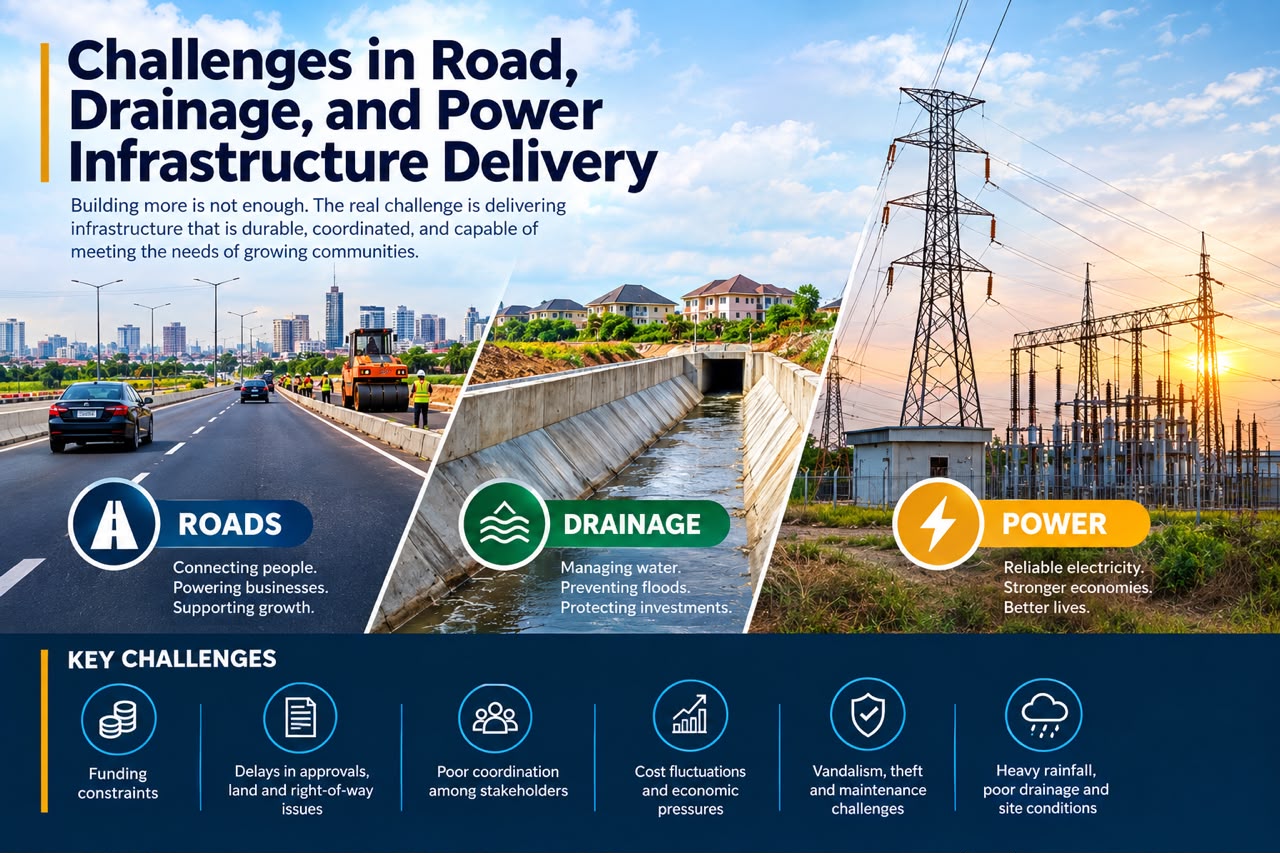
Roads, drainage systems, and power infrastructure are among the most visible measures of a country’s development. They determine how easily people move, how businesses operate, how communities respond to heavy rainfall, and how reliably essential services can function. In Nigeria, the need for better infrastructure is widely recognised; however, moving a project from planning to successful long-term use remains a complex task. The challenge is not only to build more assets, but to deliver infrastructure that is durable, coordinated, and capable of meeting the needs of growing communities.
Road infrastructure often faces pressure from inadequate planning, limited funding, right-of-way challenges, and changing site conditions. A road project may begin with a clear scope and programme, yet experience delays when utility lines, drainage channels, buildings, or land-acquisition issues are discovered during construction. In many urban areas, increasing traffic volumes also make it difficult to carry out rehabilitation works without causing severe disruption to commuters and businesses. The result is that contractors must balance construction progress with traffic management, safety, and public convenience.
Drainage presents an equally important challenge. A well-constructed road can fail prematurely if drainage is not properly designed, constructed, and maintained. During periods of heavy rainfall, blocked drains, undersized culverts, poor outfalls, and construction on natural water channels can lead to flooding, erosion, and damage to pavements. This raises an important question: can a road truly be considered complete if water has nowhere effective to flow? Drainage should not be treated as a secondary component of infrastructure delivery. It must be integrated into road design from the earliest stage, with a clear understanding of local topography, rainfall patterns, surrounding development, and future urban expansion.
Power infrastructure delivery faces its own set of constraints. Reliable electricity depends on more than generating capacity; it requires functional transmission lines, substations, distribution networks, metering systems, and effective maintenance. Delays in approvals, equipment procurement, land access, funding, and community engagement can affect project timelines. In addition, vandalism, theft of cables and equipment, and damage to installations continue to threaten the reliability of power assets after completion. A power project that is not properly protected and maintained may deliver far less value than originally intended.
Funding remains a common issue across road, drainage, and power projects. Infrastructure requires substantial upfront investment, while delays in payment can affect contractors’ ability to procure materials, retain skilled labour, and keep equipment operational. Economic fluctuations can further increase the cost of cement, steel, fuel, electrical components, and imported equipment. When project budgets are not reviewed realistically, the gap between the original estimate and the actual cost of delivery can become significant. Strong cost planning and timely funding are therefore critical to avoiding abandoned or underperforming projects.
Coordination between stakeholders is another major factor. Government agencies, consultants, contractors, utility providers, host communities, and regulatory authorities must often work together on a single project. Where communication is weak, a completed road may be excavated shortly afterwards for utility installations, or a drainage system may be obstructed by unplanned development. Better coordination can prevent duplication, reduce rework, and ensure that infrastructure investments complement rather than conflict with one another.
The solution lies in disciplined project preparation and lifecycle thinking. Feasibility studies, accurate surveys, resilient designs, transparent procurement, practical construction programmes, quality assurance, and maintenance plans must all receive appropriate attention. Communities should also be engaged early, particularly where projects affect access, livelihoods, or existing services. Infrastructure delivery is not complete at commissioning; its real success is measured by how well it performs over many years.
At Samprec Consultants Ltd, we support the delivery of road, drainage, and power infrastructure through professional project management, cost management, procurement advisory, and construction consultancy services. We help clients manage risk, coordinate stakeholders, and deliver infrastructure solutions that are practical, durable, and aligned with Nigeria’s long-term development needs.
Leave A Comment