
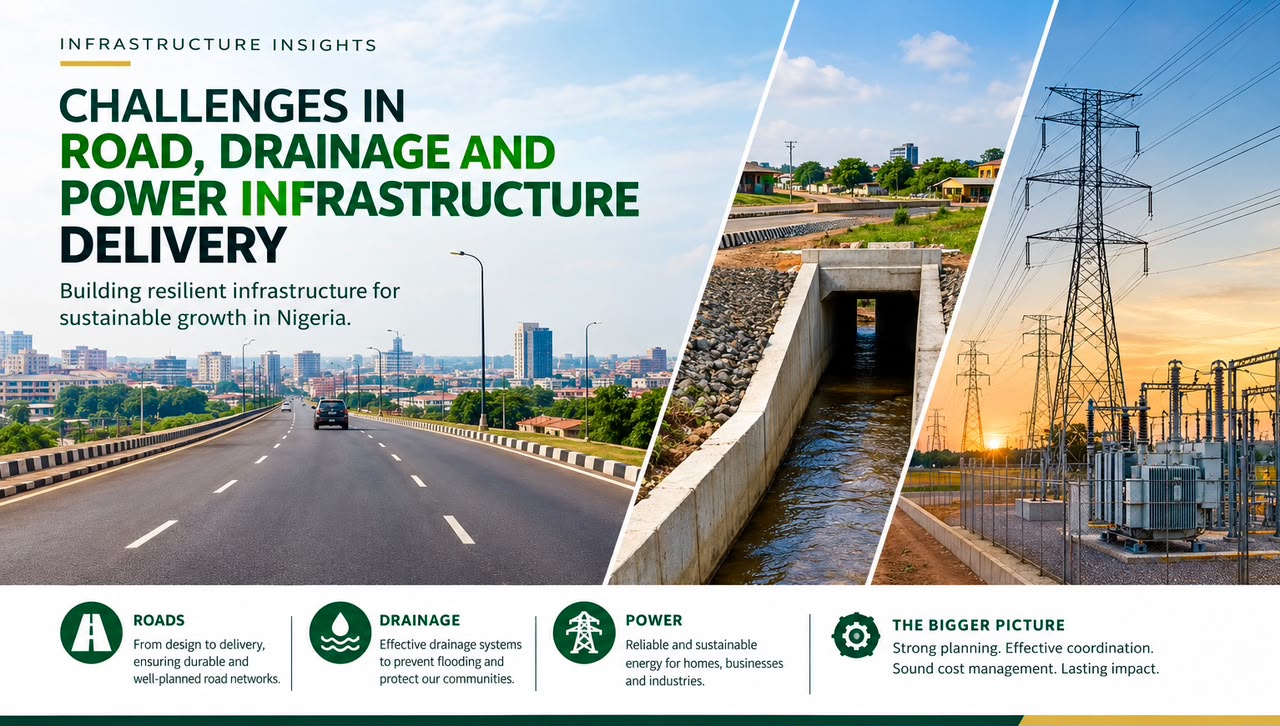
Roads, drainage systems, and power infrastructure are fundamental to economic growth, urban development, and the overall quality of life. They facilitate transportation, support commercial activities, manage stormwater, and provide the electricity required for homes, industries, and essential services. In Nigeria, the demand for these infrastructure assets continues to grow alongside population expansion, urbanisation, and economic activity. However, the challenge extends beyond the provision of new infrastructure to ensuring that projects are properly planned, efficiently executed, and capable of delivering sustainable value throughout their service life.
Road infrastructure delivery involves more than the construction of carriageways and pavements. It requires adequate feasibility studies, reliable site investigations, appropriate pavement design, effective traffic management, and careful coordination with existing utilities. Where these considerations are overlooked, projects may encounter unexpected ground conditions, utility conflicts, land acquisition disputes, and cost variations during construction. Poor workmanship, inadequate supervision, and the use of unsuitable materials can also compromise pavement performance, resulting in premature deterioration, frequent maintenance, and increased expenditure. These challenges highlight the importance of integrating sound engineering principles with effective project planning and construction management.
Drainage infrastructure presents a related but distinct set of challenges. Inadequate drainage design, blocked channels, undersized culverts, poor discharge arrangements, and uncontrolled development along natural waterways can increase the risk of flooding and erosion. In many urban areas, drainage systems are unable to accommodate the combined effects of intense rainfall, expanding built-up areas, and inadequate maintenance. The consequences often extend beyond flooding to include pavement failure, property damage, environmental degradation, and disruption of economic activities. Drainage must therefore be considered an integral component of road infrastructure, supported by appropriate hydrological studies, sound hydraulic design, effective construction supervision, and a practical maintenance strategy.
Power infrastructure delivery is equally complex, requiring coordination across generation, transmission, distribution, and supporting electrical systems. Projects may be affected by delays in equipment procurement, foreign exchange fluctuations, land access difficulties, regulatory approvals, and limitations in funding. The technical demands of installing substations, transmission lines, transformers, and distribution networks also require competent personnel, appropriate materials, and strict compliance with safety and quality standards. Beyond construction, vandalism, equipment theft, inadequate maintenance, and weaknesses in network management can undermine the reliability of completed installations. Consequently, the success of power infrastructure depends not only on the completion of physical assets but also on their operational readiness, protection, and long-term maintenance.
One of the most persistent challenges across these infrastructure sectors is inadequate cost planning and funding uncertainty. Infrastructure projects typically require substantial capital investment, while fluctuations in material prices, fuel costs, exchange rates, and equipment procurement expenses can place considerable pressure on approved budgets. Delayed payments to contractors may further disrupt procurement, labour retention, equipment utilisation, and construction schedules. Where initial estimates fail to account adequately for project risks and prevailing market conditions, cost overruns and programme extensions become increasingly likely. Realistic cost estimates, appropriate contingencies, transparent procurement, and timely financial commitments are therefore essential to maintaining project viability.
Coordination among stakeholders also plays a decisive role in infrastructure delivery. Government agencies, consultants, contractors, utility providers, regulatory authorities, and host communities often have different responsibilities and competing priorities. Weak communication and unclear lines of responsibility can lead to design inconsistencies, approval delays, duplicated works, and disputes during execution. For instance, a newly completed road may require excavation to accommodate a utility installation that was not properly coordinated during the initial planning stage. Similarly, drainage works may be rendered ineffective by subsequent development that obstructs natural watercourses. Early stakeholder engagement, integrated design reviews, and clear project governance can minimise these conflicts and improve the efficient use of resources.
Addressing these challenges requires a comprehensive approach that connects project preparation, technical design, financial management, construction supervision, and asset maintenance. Feasibility studies and site investigations must provide a reliable basis for design decisions, while procurement strategies and construction programmes should reflect actual project conditions and foreseeable risks. Effective quality assurance, competent project management, transparent reporting, and rigorous cost control are equally important. Furthermore, infrastructure planning should consider the relationship between roads, drainage, and power networks rather than treating them as isolated investments. Such integration can reduce rework, improve resilience, and ensure that public expenditure produces lasting benefits.
At Samprec Consultants Ltd, we recognise that successful infrastructure delivery depends on more than completing construction activities. It requires professional coordination, informed decision-making, effective risk management, and a clear understanding of each project’s technical and commercial demands. Through our project management, cost management, procurement advisory, and construction consultancy services, we support clients in navigating infrastructure delivery challenges and achieving better project outcomes. Our focus is on promoting practical, cost-conscious, and sustainable infrastructure solutions that contribute to Nigeria’s long-term development.
Leave A Comment