
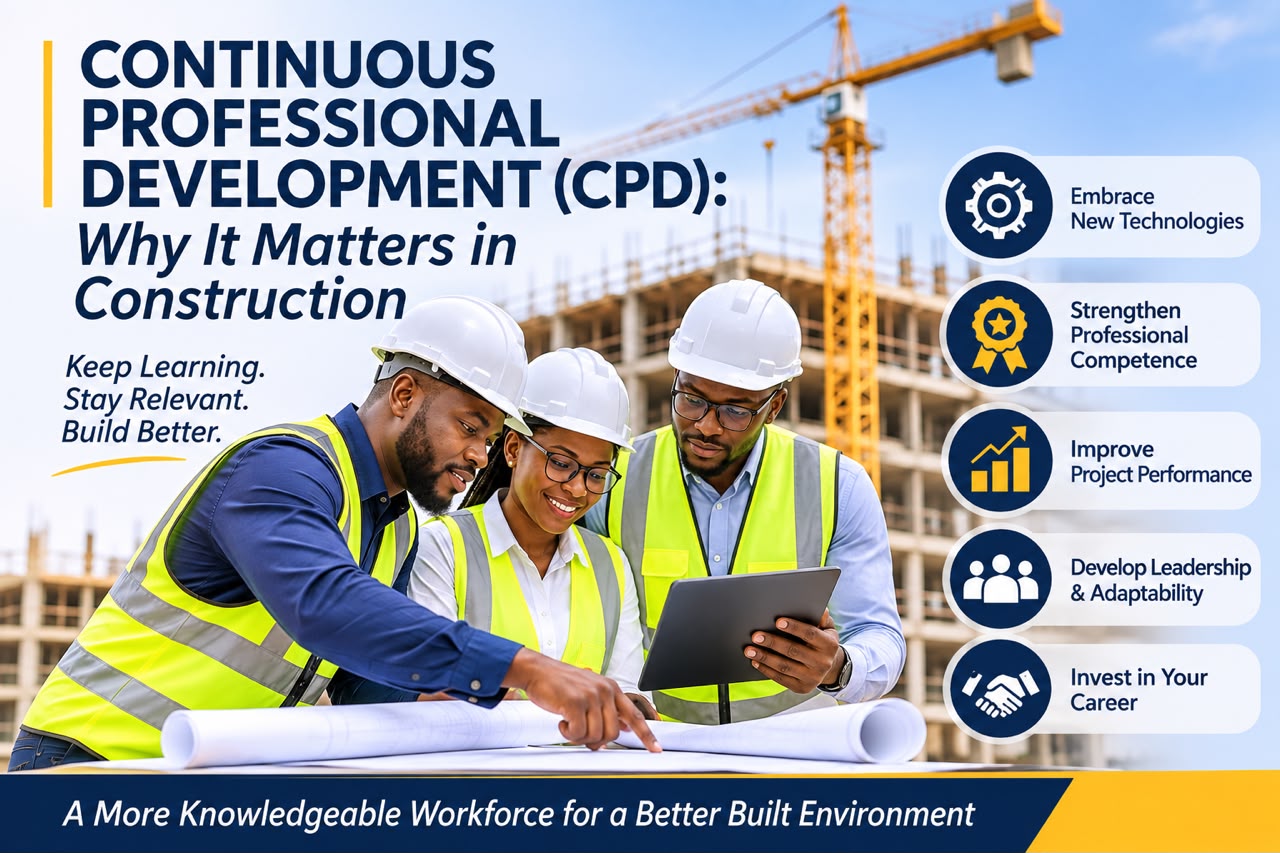
The construction industry is constantly evolving, influenced by technological advancements, changing regulations, new construction methods, and increasing expectations for project quality and efficiency. Professionals working within the industry are required to make decisions that affect project costs, safety, structural integrity, programme delivery, and long-term asset performance. As construction projects become more complex, the knowledge and skills acquired through formal education and initial professional training may no longer be sufficient to address emerging industry demands. Continuous Professional Development (CPD) therefore plays an important role in ensuring that construction professionals remain competent, informed, and capable of responding to changes within the industry.
One of the primary reasons continuous professional development matters is the changing nature of construction technology and project delivery methods. The adoption of Building Information Modelling (BIM), digital project management platforms, artificial intelligence, drone technology, and automated construction processes is changing how projects are planned, designed, monitored, and executed. Professionals who do not update their technical knowledge risk falling behind industry developments and may struggle to take advantage of opportunities to improve productivity and project performance. Continuous learning helps professionals understand these technologies, assess their practical applications, and incorporate appropriate innovations into their daily responsibilities.
Professional competence is another important consideration. Construction projects involve multiple disciplines, including architecture, engineering, quantity surveying, project management, procurement, and facility management. Each discipline requires specialised knowledge, but effective project delivery also depends on professionals understanding how their responsibilities interact with those of other project participants. Changes in construction standards, contract administration procedures, procurement practices, health and safety requirements, and regulatory frameworks can directly affect professional responsibilities. CPD provides an opportunity to strengthen existing competencies, address knowledge gaps, and remain familiar with current industry requirements. In Nigeria, where professionals operate within evolving regulatory and economic conditions, staying informed is particularly important.
The relationship between professional development and project performance is equally significant. Inadequate knowledge or outdated practices can contribute to poor cost estimates, ineffective project scheduling, procurement errors, contractual disputes, construction defects, and weak risk management. These issues may result in cost overruns, programme delays, compromised quality, and reduced client confidence. Continuous professional development helps professionals improve their technical judgement, decision-making abilities, and understanding of project management principles. By strengthening these capabilities, organisations can improve the quality of professional input and reduce avoidable errors throughout the project lifecycle.
Leadership and professional adaptability also benefit from continuous learning. As professionals progress into senior positions, their responsibilities increasingly extend beyond technical tasks to include team leadership, stakeholder coordination, conflict resolution, commercial decision-making, and strategic planning. Technical expertise alone may not adequately prepare an individual for these responsibilities. Training in leadership, communication, negotiation, financial management, and strategic thinking helps professionals manage increasingly complex assignments and contribute more effectively to organisational objectives. This is particularly relevant in the construction industry, where successful project delivery often depends on the ability to coordinate different interests and resolve competing priorities.
Despite its importance, continuous professional development is not without challenges. Work pressures, demanding project schedules, training costs, limited access to quality learning opportunities, and organisational constraints can make it difficult for professionals to participate in structured development programmes. Some individuals also approach CPD primarily as a requirement for maintaining professional membership rather than as an opportunity to improve their competence. This limits its potential value. Professional development should therefore be approached as a deliberate investment in career growth and professional effectiveness, supported by organisations that recognise the long-term benefits of developing their workforce.
Achieving meaningful professional development requires a structured and practical approach. Professionals should regularly assess their knowledge gaps, identify relevant learning objectives, and participate in activities that align with their responsibilities and career aspirations. These activities may include professional training, industry conferences, technical workshops, research, mentoring, online learning, and knowledge-sharing sessions. Construction firms also have a responsibility to create an environment that encourages learning, supports professional qualifications, and provides opportunities for employees to apply newly acquired knowledge. The effectiveness of CPD should ultimately be measured not only by attendance certificates or accumulated learning hours, but by improvements in professional competence, workplace performance, and project outcomes.
At Samprec Consultants Ltd, we recognise that the quality of construction project delivery is closely linked to the knowledge, competence, and professional capacity of the people responsible for it. Through our consultancy and professional development initiatives, including Samprec Academy, we support the continuous growth of construction and project management professionals through relevant training, industry-focused learning, and professional development programmes. We believe that investing in professional knowledge is essential to building a more competent workforce, strengthening industry standards, and improving the overall quality of construction delivery in Nigeria.
Leave A Comment